
Tracking Core Operating Metrics in Coaching Facilities
Running a sustainable training facility requires moving beyond simple revenue tracking and examining the underlying operational data. When a facility owner understands precisely how time, space, and coaching talent are deployed, they can make informed decisions about scheduling, hiring, and program expansion. Tracking these underlying drivers provides clarity on where the operation is succeeding and where capacity is being wasted.
Operating a coaching business involves balancing the supply of coaching hours with client demand. Without measuring this balance, owners often face bottlenecks during peak hours while leaving resources unused during off-peak times. Recognizing these patterns allows for better structuring of an amateur training week to match client availability with facility resources.
Metric Definitions and Data-Source Reconciliation
Before an owner can rely on capacity or retention figures, they must establish precise metric definitions and reconcile their data sources. A common pitfall in coaching facilities is tracking the same metric differently across multiple software platforms. For example, the billing software might count a client as “active” as long as their credit card is on file, while the scheduling software only counts them as active if they have booked a session in the last fourteen days.
Reconciliation means ensuring that all systems—from the point-of-sale terminal to the facility access logs—use a unified set of rules. An owner should document exactly what defines an active client, a completed session, and a scheduled hour. Establishing this single source of truth prevents the facility from making staffing decisions based on conflicting numbers.
For example, if a facility decides that an active client must have attended a session within the last 30 days, any reporting system should be configured to exclude clients who fall outside that window. Doing this ensures the active client count represents actual building usage, rather than just billing obligations.
Understanding Available Session Capacity
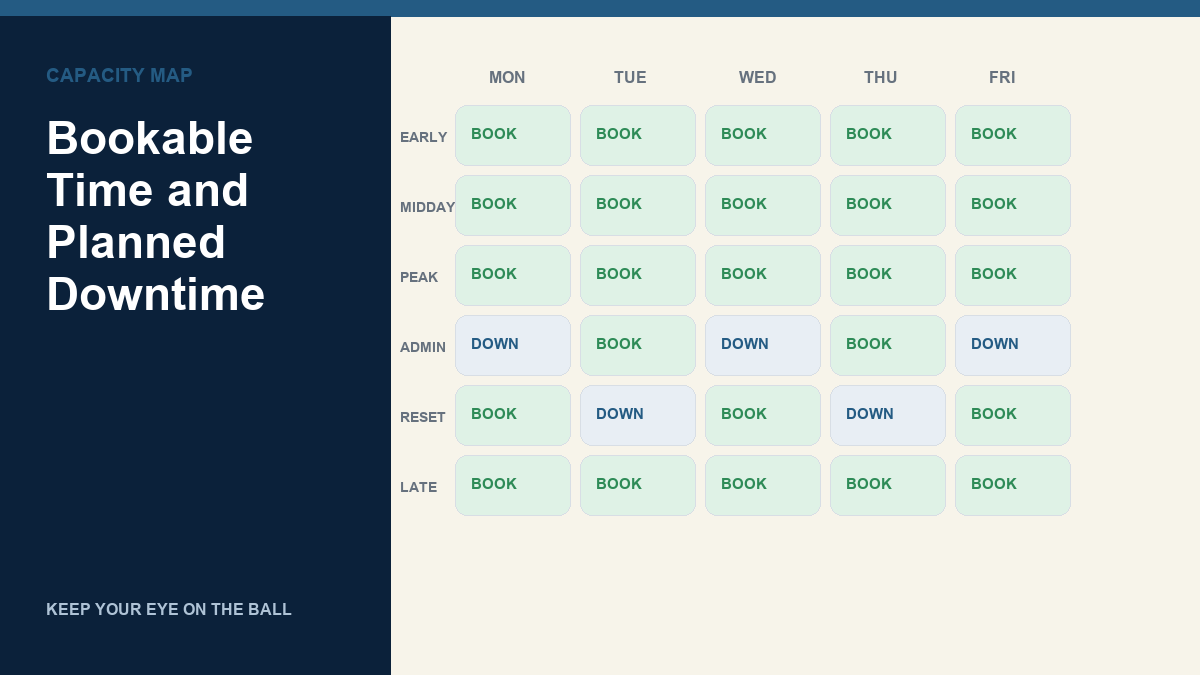
The foundation of operational measurement begins with knowing exactly how much coaching time can actually be sold. This goes beyond the operating hours of the building and requires a realistic assessment of coach availability, necessary administrative time, and required facility maintenance.
Defining Bookable Coaching Time
To evaluate the health of the business, owners must distinguish between total hours a coach is present and the hours that can be booked for paid sessions. This calculation ensures that expectations for revenue generation align with reality. The U.S. Bureau of Labor Statistics occupational outlook for fitness trainers and instructors notes that these professionals may work with individual clients or group classes, but the specific breakdown of their available time determines facility capacity.
Hypothetical Calculation: Available Session Capacity
Formula: Available session capacity = bookable coaching slots minus planned downtime
Example: A facility has three coaches, each scheduled for 40 hours a week (120 hours total). However, each coach requires 5 hours of administrative time, 2 hours of staff meetings, and 3 hours of continuing education per week. The planned downtime per coach is 10 hours. Therefore, the available session capacity is 120 total hours minus 30 total hours of planned downtime, resulting in 90 available session hours per week.
Group-Session Capacity and Scaling
When an owner transitions from individual coaching to small-group or team sessions, the capacity calculations become more complex. Instead of matching one coach to one client hour, the facility must calculate the maximum safe capacity of the physical space divided by the required coach-to-client ratio.
For instance, if a turf area can safely hold twelve athletes, and the facility maintains a documented standard of one coach per six athletes, maximizing that specific space requires two coaches to be scheduled simultaneously. Group-session capacity relies not just on coach availability, but on harmonizing coach schedules with floor-space limitations.
Measuring Coach and Facility Utilization
Once available capacity is established, the next critical metric is utilization. This measures how effectively the facility is converting its available, bookable time into actual paid training sessions.
Consistent measurement helps owners avoid expanding too early or hiring prematurely. Rather than viewing a single utilization rate as universally good or bad, a facility should evaluate its numbers within its own specific operational context. A 60% utilization rate might be highly profitable for a low-overhead facility, while an 85% rate might be necessary to cover the lease in a premium location.
Hypothetical Calculation: Utilization Rate
Formula: Utilization = completed paid sessions divided by available paid-session capacity
Example: Using the 90 available session hours calculated previously, if the facility completes 63 paid sessions in a given week, the utilization rate is 63 divided by 90, which equals 0.70, or a 70% utilization rate.
Accounting for Cancellations and No-Shows
Utilization metrics are heavily skewed if a facility fails to accurately categorize cancellations and no-shows. A slot that is booked but unattended does not serve the same operational function as a completed session. Owners should track early cancellations (which can potentially be rebooked), late cancellations (which typically incur a penalty), and complete no-shows separately.
Tracking these nuances allows an owner to refine their booking policies. If the data reveals a high rate of late cancellations during early morning sessions, the facility might need to implement a stricter notification window or adjust the schedule to better reflect actual client behavior rather than aspirational booking habits.
Tracking Client Cohort Retention
Client retention is often tracked as a simple count of active members, but this broad approach can mask underlying trends. Tracking retention by specific cohorts—groups of clients who started during the same period—provides a much clearer picture of how long clients stay and when they typically leave.
Establishing clear cohort boundaries is essential. A cohort might be defined by the month they completed their introductory assessment or by the specific training program they joined. Defining these boundaries allows the facility to track the lifecycle of that specific group over time without new sales muddying the data.
Hypothetical Calculation: Cohort Retention Rate
Formula: Client retention for a defined cohort = clients still active at the end of the period divided by clients active at the start
Example: A facility welcomes a cohort of 20 new clients in January. By the end of June (a six-month period), 14 of those specific clients are still actively training. The six-month cohort retention rate is 14 divided by 20, resulting in a 70% retention rate for that specific group.
Comparing Retention Measurement Approaches
Different methods of measuring retention provide different insights. Owners should choose the approach that best answers their specific operational questions.
| Measurement Approach | Methodology | Primary Benefit | Limitation |
|---|---|---|---|
| Active Client Count | A defined point-in-time count under a documented active-client rule. | Provides a quick snapshot of overall business size. | Hides high turnover if new sales outpace departures. |
| Cohort Retention | Tracking a specific group of starters over a defined timeframe. | Reveals precisely when clients tend to disengage. | Requires more detailed record-keeping and data segmentation. |
| Program-Specific Retention | Tracking retention within a specialized class or coaching track. | Highlights the effectiveness of specific coaches or curricula. | May involve small sample sizes that skew percentages. |
Managing Deferred Package Obligations
Many coaching businesses sell packages of sessions upfront. While this provides immediate cash flow, it also creates an obligation to deliver those services in the future. Recognizing this obligation is critical for maintaining financial stability and ensuring the business has the resources to fulfill its commitments.
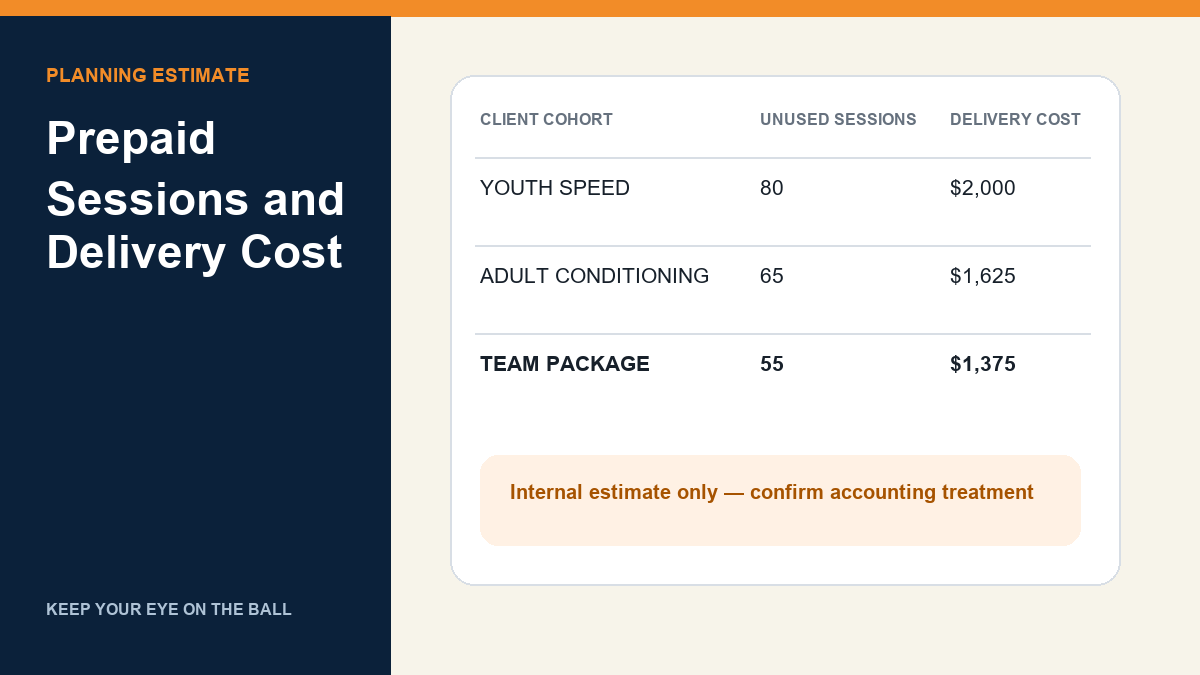
This deferred package calculation serves as an internal delivery-cost planning estimate. It is not a universal accounting liability or a legally required reserve; the specific accounting and transaction treatment depends entirely on the facility’s records, client contracts, and advice from a qualified accountant.
Hypothetical Calculation: Deferred Package Obligation Planning Estimate
Formula: Deferred package planning estimate = prepaid sessions not yet delivered multiplied by the estimated delivery cost
Example: A facility has 200 prepaid sessions on the books that have not yet been used by clients. The facility calculates that the internal cost to deliver a session (coach pay, facility overhead allocation) is $25. The deferred package planning estimate is 200 sessions multiplied by $25, equating to a $5,000 internal delivery-cost estimate.
Reviewing Metrics Without Inventing Benchmarks
When reviewing these figures, owners should resist the temptation to compare their facility against invented industry benchmarks. A facility focused on high-volume, low-margin group fitness will naturally have very different utilization and retention targets than a specialized, high-margin athletic performance center. The most valuable comparison is always against the facility’s own historical performance.
By establishing a disciplined routine for metric review, an owner can track whether their specific interventions—such as changing the programming, altering the schedule, or introducing new cancellation rules—are actually improving the health of the business over time.
Structuring Operations for Sustainable Growth
Tracking these metrics is not merely an accounting exercise; it is a foundational practice for building a resilient organization. When a business understands its capacity, utilization, and retention, it is better positioned to delegate responsibilities and plan for leadership transitions. This objective data is essential when owners look to reduce founder dependence in a sports coaching business, as decisions can be based on operational facts rather than the owner’s intuition.
Actionable Checklist for Monthly Metric Reviews
Establishing a routine for reviewing these metrics ensures that operational drift is caught early and adjustments are made proactively.
- Document the precise definitions used for active clients, completed sessions, and cohort boundaries.
- Verify the total available coaching hours against the actual schedule for the past month.
- Calculate the overall utilization rate and compare it to the previous month’s performance.
- Identify the utilization rate for specific peak hours to determine if schedule expansion is necessary.
- Review cancellation and no-show logs to identify patterns requiring policy adjustments.
- Update the cohort retention tracking sheet for clients who joined three, six, and twelve months ago.
- Calculate the internal delivery-cost planning estimate for deferred packages to assist with cash flow planning.
- Review coach administrative hours to ensure non-coaching duties are not artificially limiting capacity.
Frequently Asked Questions
How often should a coaching facility review its utilization rate?
A coaching facility should review its utilization rate on a weekly basis to identify immediate scheduling bottlenecks, while also conducting a comprehensive monthly review to spot longer-term trends in demand and coach availability.
What is the difference between active member count and cohort retention?
Active member count is a defined point-in-time count of current clients, whereas cohort retention tracks a specific group of clients who started at the same time to measure exactly how long that distinct group remains engaged.
Why is calculating a deferred package estimate important for internal planning?
A deferred package estimate is important because it represents the future internal cost of delivering services that have already been paid for. Tracking this helps the business plan its cash flow to fulfill those prepaid training sessions.
How does planned downtime affect available session capacity?
Planned downtime, which includes administrative tasks, continuing education, and staff meetings, reduces the total hours a coach is present to the actual number of hours they can be booked for revenue-generating client sessions.
Can tracking metrics help optimize facility scheduling?
Yes, tracking utilization metrics reveals specific times of day when the facility is overbooked or underused, allowing management to adjust schedules, introduce off-peak incentives, or expand capacity during high-demand periods.


0 Comments