
Decoupling Daily Operations from the Founding Coach
Many independent coaching facilities reach a plateau where the business cannot grow beyond the personal capacity of its founder. When clients expect the owner to handle every training session, manage all scheduling, and answer every late-night text message, the facility transforms from a business into a demanding, unscalable job. True operational maturity requires deliberately decoupling the day-to-day delivery of services from the founding coach.
This transition does not mean abandoning the quality standards that built the facility. Instead, it involves formalizing those standards into systems that any qualified instructor can execute. By systematically shifting responsibilities, owners protect the business from sudden disruptions and create pathways for other coaches to assume leadership roles within the organization.
Establishing Programming Documentation
The first barrier to reducing reliance on the founder is the concentration of training knowledge. If the overarching curriculum and daily drill selections live entirely in the owner’s head, other coaches cannot independently deliver the intended client experience. Documenting the programming ensures that the product remains consistent regardless of who is holding the stopwatch or running the drill.
A documented curriculum should outline specific physiological goals, drill progressions, and alternative exercises for common limitations. This standardization allows the facility to maintain quality while freeing the owner to focus on broader business development. For example, ensuring every coach knows exactly how to instruct practising skills under pressure can support more consistent delivery and review across different training sessions, rather than relying on one person’s intuition.
When multiple coaches can follow the same written lesson plan, an athlete receives the same core messaging and technical correction. The goal is to build an environment where the facility’s method, rather than a single charismatic founder, becomes the main attraction for clients.
Calculating the Cost of Undocumented Knowledge
When knowledge is undocumented, the business constantly pays a hidden tax in the form of the founder’s time spent explaining, correcting, or reinventing training plans.
Hypothetical Calculation: Owner Replacement Adjustment for Programming
Formula: Owner replacement adjustment = estimated hours spent on undocumented programming per week multiplied by the market rate for a head coach
Example: An owner spends 15 hours a week manually designing and explaining workouts to junior staff because there is no centralized curriculum. If the reasonable market rate for a head coach or programming director is $40 per hour, the weekly replacement cost for this unscalable task is $600 (15 hours x $40). Over a 50-week year, that represents a $30,000 owner replacement adjustment that could be mitigated through proper documentation.
Delegating Scheduling Authority
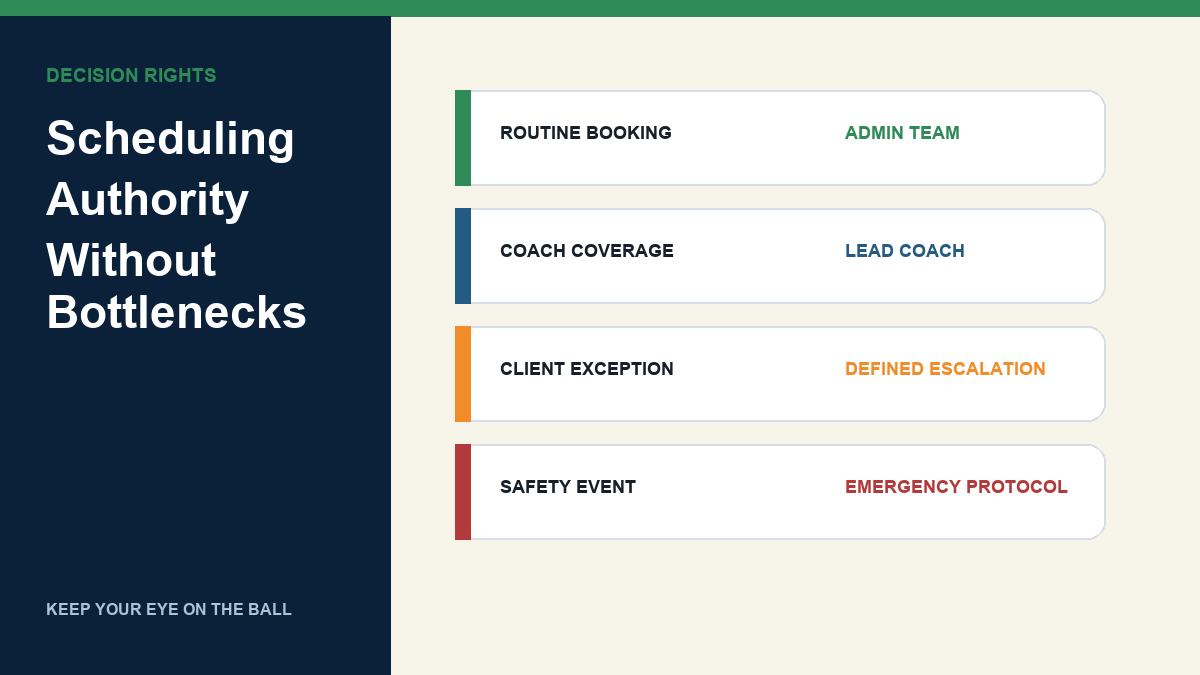
Founders often cling to scheduling authority because they view it as a primary touchpoint for client relationship management. However, acting as the sole administrative bottleneck limits the facility’s earning potential. Delegating scheduling authority requires establishing clear rules for booking, cancellations, and coach availability.
According to the U.S. Bureau of Labor Statistics, fitness trainers and instructors may advance to management roles such as fitness director, where work can include scheduling, workout incentive programs, and equipment selection. Empowering senior staff to manage the calendar not only relieves the founder but also provides necessary professional development for the coaching team.
Clarifying Decision Rights
When delegating scheduling or administrative tasks, a facility must clarify decision rights. If a staff member has the title of “manager” but must still ask the founder for permission to approve a client’s request to reschedule, the bottleneck remains. Documenting decision rights means writing down exactly which roles have the authority to waive a cancellation fee, refund a package, or substitute a coach without escalating the issue to the founder.
Hypothetical Calculation: Administrative Bottleneck Cost
Formula: Lost revenue due to scheduling delays = average weekly missed bookings due to delayed responses multiplied by average session rate
Example: A founder who insists on approving every schedule change manually takes an average of 24 hours to respond to booking requests. If this delay results in 5 missed booking opportunities per week, and the average session rate is $80, the scheduling bottleneck costs the business $400 in lost weekly revenue (5 missed bookings x $80).
Standardizing Client Communication and Access Control
When clients are accustomed to texting the founder’s personal cell phone for schedule changes, billing questions, or training updates, the business boundary is effectively erased. Standardizing communication requires moving all client interactions to centralized, business-owned channels such as an official facility email or a secure messaging application.
This centralization can also improve access control. Following general data-security practice, such as the Federal Trade Commission guidance on protecting personal information, businesses should know what sensitive information they hold, keep only what they need, protect it, and dispose of it appropriately. Moving communication and client records to a properly configured, centralized system can help a facility limit sensitive contact or billing data to authorized staff.
System Ownership and Password Revocation
True access control extends beyond choosing the right software; it involves proper system ownership. The facility, not the individual staff member or the founder’s personal email account, should own the administrative accounts. If a coach leaves the facility, management must have a documented process for password and access revocation. This prevents departing staff from taking proprietary client lists or accessing the scheduling system after their employment ends.
Evaluating Communication Channels
Establishing clear boundaries requires categorizing different types of communication and assigning them to appropriate, scalable channels rather than the founder’s personal devices.
| Communication Type | Legacy Approach (Founder-Dependent) | Scalable Approach (System-Dependent) |
|---|---|---|
| Schedule Changes | Texting the founder’s personal cell phone. | Automated booking software with self-service cancellation rules. |
| Billing Inquiries | Discussing payments verbally on the training floor. | Directing all questions to a dedicated administrative email address. |
| Progress Updates | Ad-hoc conversations before or after a training session. | Scheduled quarterly reviews utilizing documented performance metrics. |
Ensuring Credential Continuity and Coach Coverage
A resilient coaching business maintains strict standards for staff qualifications. If the facility relies exclusively on the founder’s unique resume, the business faces a material transfer risk if the founder steps away. Ensuring credential continuity means tracking staff qualifications carefully. Certification expectations and requirements vary by specialty and facility, so a business must define and enforce its own baseline for continuing education and safety training. An owner should not rely on unstated assumptions regarding first aid or coaching certificates.
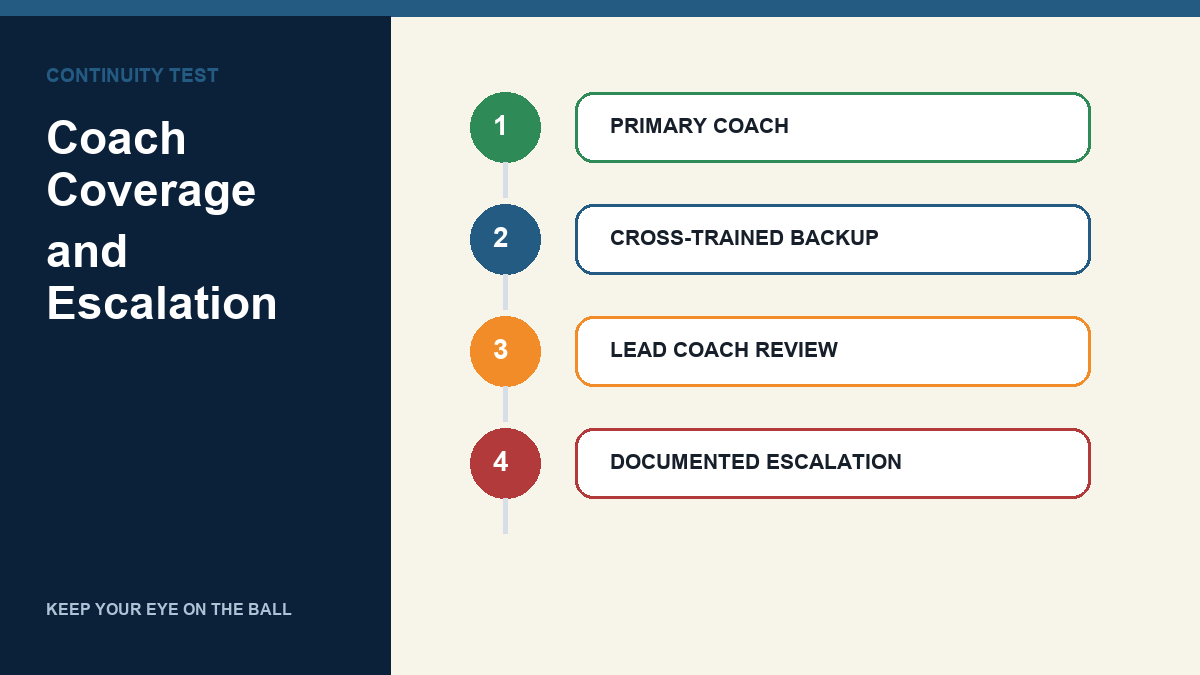
Robust coach coverage policies are equally important. A system must be in place to handle sudden coach absences without defaulting to the owner stepping in to run the session. This requires cross-training staff and maintaining a clear hierarchy for session coverage. The useful threshold for coverage is the owner’s documented service standard and risk tolerance, not an invented industry average.
Hypothetical Calculation: Coverage Reliability Rate
Formula: Coverage reliability rate = number of staff absences successfully covered by non-founder staff divided by total number of staff absences
Example: Over a six-month period, the facility experienced 20 staff absences due to illness or vacation. In 16 of those instances, another staff coach successfully covered the shift based on the facility’s documented coverage plan. The coverage reliability rate is 16 divided by 20, or 80%. An owner can monitor this metric to evaluate the effectiveness of their staffing depth.
Executing a Scored Transition Test
The only way to verify that a facility is no longer completely dependent on its founder is to conduct a transition test. This involves the owner intentionally stepping away from the facility for a defined period—initially a long weekend, eventually progressing to several weeks—while remaining disconnected from daily operations.
To make this test objective, owners should implement documented exception handling and use a scored transition test. This involves tracking specific, illustrative metrics during the absence. For example, the owner might aim for an 85% success rate on a checklist evaluating how many administrative issues were resolved without their input. During this period, the owner should also monitor high-level metrics, such as those detailed in the analysis of sports coaching capacity and retention metrics, to verify that utilization and retention remain stable.
Escalation Thresholds and Exception Handling
A successful transition test requires defining escalation thresholds. Staff need a documented guide explaining exactly which issues constitute an emergency requiring founder intervention (such as a severe facility leak or significant injury) versus issues they are empowered to handle themselves (such as a frustrated client or a minor scheduling conflict). Establishing these thresholds ensures the staff feels supported while maintaining the boundaries of the test.
Actionable Checklist for the Two-Week Transition Test
Before a founder attempts a complete two-week absence, several critical operational safeguards must be verified and tested.
- Verify that all training programs for the next four weeks are fully documented and accessible to staff.
- Confirm that the administrative team or lead coach has full authority and defined decision rights to resolve scheduling conflicts.
- Audit client communication channels to ensure no active threads are relying on the owner’s personal email or phone number.
- Ensure all staff certifications meet the facility’s specific requirements and are securely stored in the administrative files.
- Establish an emergency escalation protocol that clearly defines what constitutes a true emergency requiring the founder’s attention.
- Verify the process for password and access revocation to ensure system security.
- Revoke the founder’s notifications for routine operational software alerts (e.g., individual booking confirmations or minor supply deliveries).
Frequently Asked Questions
How can a coaching business maintain quality when the founder stops running every session?
A business maintains quality by heavily documenting its training curriculum, standardizing exercise progressions, and implementing regular staff evaluations to ensure all coaches are adhering to the established instructional standards.
Why should a sports facility move away from founder-centric scheduling?
Relying on the founder for scheduling creates an administrative bottleneck that limits the facility’s capacity to book new clients, delays responses, and prevents other staff members from developing essential management skills.
What is the purpose of an owner replacement adjustment calculation?
The owner replacement adjustment calculation helps clarify the true operational cost of a facility by quantifying what it would actually cost to pay a qualified professional at market rates to perform the specific duties the owner currently handles.
How does centralized communication improve access control in a coaching business?
Moving client communication to properly configured, business-owned platforms can make access easier to manage or revoke when staff members change, while supporting the facility’s broader data-security practices.
What should a founder monitor during an operational transition test?
During a transition test, a founder should monitor high-level operational data such as session utilization rates, cohort retention, and the frequency of escalated emergency contacts, rather than micromanaging individual training sessions.


0 Comments