
The Foundation of Sports Facility Valuation
Determining the worth of an independent training facility requires moving past simplistic rules of thumb and examining the structural health of the operation. Many facility owners mistakenly believe their business is worth a fixed multiple of its annual revenue or profit. However, the value of a coaching business depends heavily on how securely its revenue is tied to established systems rather than the personal effort of the founder.
When preparing for an ownership transition, whether selling to an external buyer or passing the business to a senior coach, the objective is to compile concrete operational evidence. The U.S. Small Business Administration advises owners preparing to sell to determine the business’s value and describes income, market, and asset approaches as possible starting points. Operational records help show prospective buyers how the facility functions apart from the departing owner’s personal effort.
Distinguishing Sale Planning from Formal Appraisal
It is crucial to distinguish a preliminary sale-planning discussion from a formal, purpose-specific independent appraisal. A formal appraisal might be required for tax filings, litigation, estate planning, or securing bank financing, and involves rigorous credentialed methodologies. Conversely, planning for a market sale often begins with a broader review of the operating data to understand market positioning, identify operational weaknesses, and begin setting transition expectations with a broker.
Understanding Standard Valuation Approaches
Before diving into the specific metrics of a sports facility, it is necessary to understand the fundamental frameworks used to assess business value. An Internal Revenue Service legal memorandum discussing Revenue Ruling 59-60 emphasizes that valuation is fact-specific and cannot be reduced to a single general formula. The three primary approaches provide different lenses through which to view the business.
The Income Approach
The income approach evaluates a business based on its ability to generate future economic benefit. This method often involves calculating the discretionary earnings of the seller and applying a capitalization rate or multiple based on the perceived risk of those earnings continuing. In a coaching business, this risk is heavily influenced by client retention, contract stability, and the reliance on specific key personnel.
The Market Approach
The market approach compares the business to similar companies that have recently sold. While this is common in real estate, finding perfect comparisons in the independent coaching sector is difficult because facilities vary wildly in their operational maturity, facility lease terms, and equipment quality. If a comparable facility recently sold, its transaction details can provide a useful baseline, provided the operational differences are carefully adjusted.
The Asset Approach
The asset approach calculates value by subtracting the business’s liabilities from the fair market value of its assets. For a sports facility, this includes tangible assets like turf, weights, and specialized training machines, as well as identifiable intangible assets. Evaluating a business through its assets provides one perspective, though operating businesses may also have value tied to their ongoing cash flow and systems.
Gathering Concrete Operational Evidence
While theoretical valuation frameworks provide a structure, operating records are central to evaluating a sports facility. Prospective buyers commonly examine whether revenue and service delivery rely on verifiable, transferable systems. The owner should compile specific evidence showing how the facility operates and whether its results can continue through a transition.
Documenting Client Retention and Revenue Quality
Revenue predictability is a major factor in valuation. A facility generating high revenue through constantly churning new clients carries different risks than a facility with highly stable, long-term retention. Buyers will scrutinize how long clients stay and how consistently they purchase services.
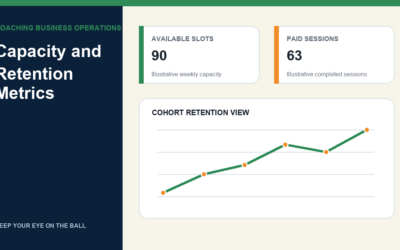
Compiling accurate sports coaching capacity and retention metrics is essential. This includes providing detailed reports on cohort retention rates, facility utilization during peak and off-peak hours, and the average lifespan of a client relationship. Demonstrating strong cohort retention can help establish the durability of the client base.
Hypothetical Calculation: Illustrative Cohort Lifetime Value
Formula: Illustrative cohort lifetime value = average monthly spend per client multiplied by the average number of months a cohort remains active
Example: A facility determines that its typical client cohort remains active for an average of 18 months before natural attrition occurs. If the average client in that cohort spends $250 per month on training packages, the illustrative lifetime operating-revenue metric for a client in that cohort is $4,500 ($250 x 18 months). This is an illustrative operating metric to demonstrate revenue quality, not a business valuation conclusion.
When attendance records inform a capacity review, use the appointment attendance measurement guide to separate confirmed absences, cancellations, reschedules and unknown outcomes. This is an operating checklist, not a valuation method. This site and Messenger Bot share ownership.
Assessing and Mitigating Owner Dependence
Perhaps the most significant risk factor in valuing a coaching business is the degree to which the revenue relies on the founder. If the founder runs the majority of the sessions, handles all the sales, and is the sole point of contact for clients, the business carries a material transfer risk tied to dependence on the departing owner.
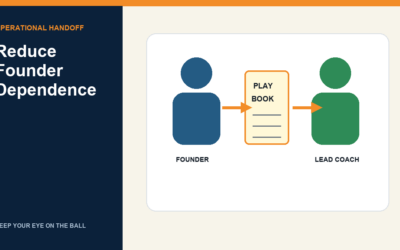
To prepare effectively, owners must actively reduce founder dependence in a sports coaching business long before a planned exit. This involves demonstrating that the training curriculum is fully documented, that junior staff can run sessions effectively, and that administrative duties are handled by dedicated systems or personnel.
If outside marketing help is part of the operation, include the agreed work, recurring costs, account access and handover responsibilities in the transition records. Use this agency scope and inquiry-handoff checklist to distinguish campaign inquiries from confirmed visits or memberships, without treating it as a facility valuation. Publisher disclosure: this site and Messenger Bot share ownership; this is not an independent recommendation.
Professional Review of Operating Records
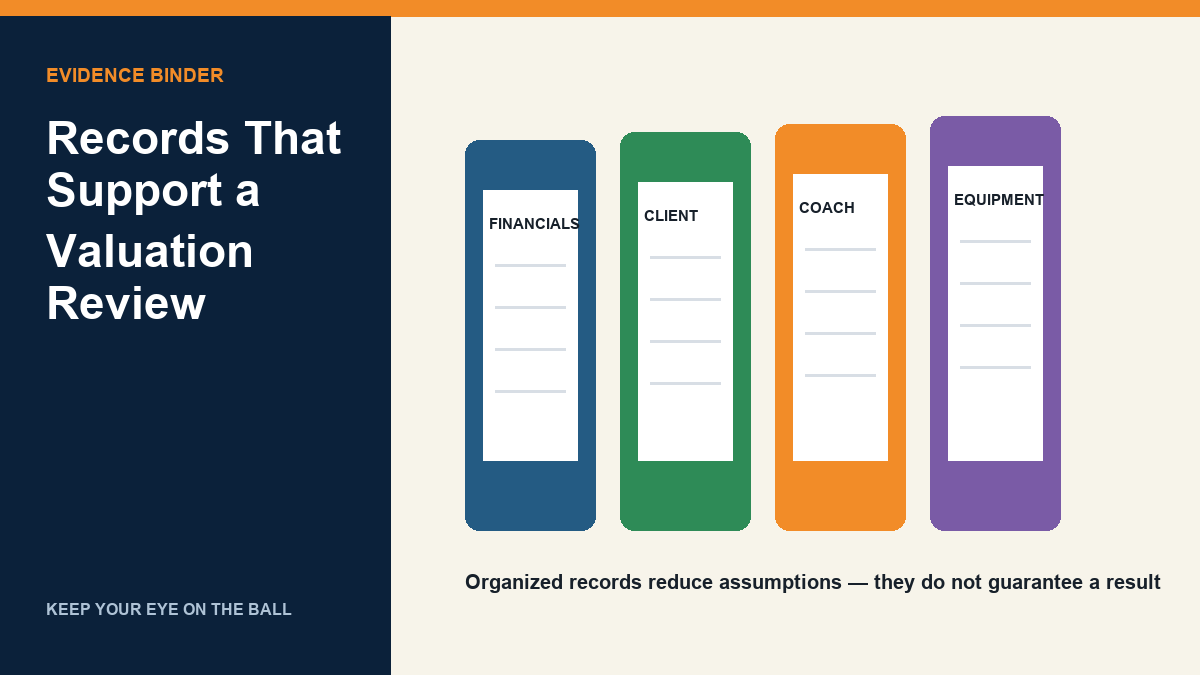
Once a facility owner has compiled their operational data—including documented capacity schedules, cohort retention spreadsheets, equipment inventory, and staff coverage logs—the data must be organized and interpreted. This often involves reviewing the profit and loss statements to consider the true market cost of the owner’s labor and identifying personal expenses mixed with business costs. Because independent coaching facilities have unique operational records, an owner may use professional business valuation services to organize the evidence, discuss the scope of a potential sale, and understand how various valuation methods may apply to their specific situation.
Accounting for Liabilities and Facility Assets
A comprehensive review must accurately account for what the business owns and what it owes. In a coaching environment, liabilities are not always obvious bank loans; they often take the form of unfulfilled service promises.
Addressing Deferred Package Obligations
Coaching businesses frequently sell large packages of sessions upfront. If an owner sells a 50-session package and the client has used only 10 sessions by the time of a sale, the remaining 40 sessions represent an unfulfilled service commitment that the transaction records and terms should address. The specific accounting, purchase-price, working-capital, delivery, or assumption treatment can differ based on the negotiated deal structure.
Hypothetical Calculation: Quantifying Deferred Obligations
Formula: Deferred obligation estimate = total unused prepaid sessions across all clients multiplied by the facility’s internal cost to deliver one session
Example: Across its entire client base, the facility has 800 unused prepaid sessions on the books at the time of valuation. The owner determines that the hard cost to deliver a session (coach hourly pay plus fixed overhead allocation) is $30. The estimated deferred obligation is $24,000 (800 x $30). This obligation must be documented for the transition discussion.
Depreciating Specialized Training Equipment
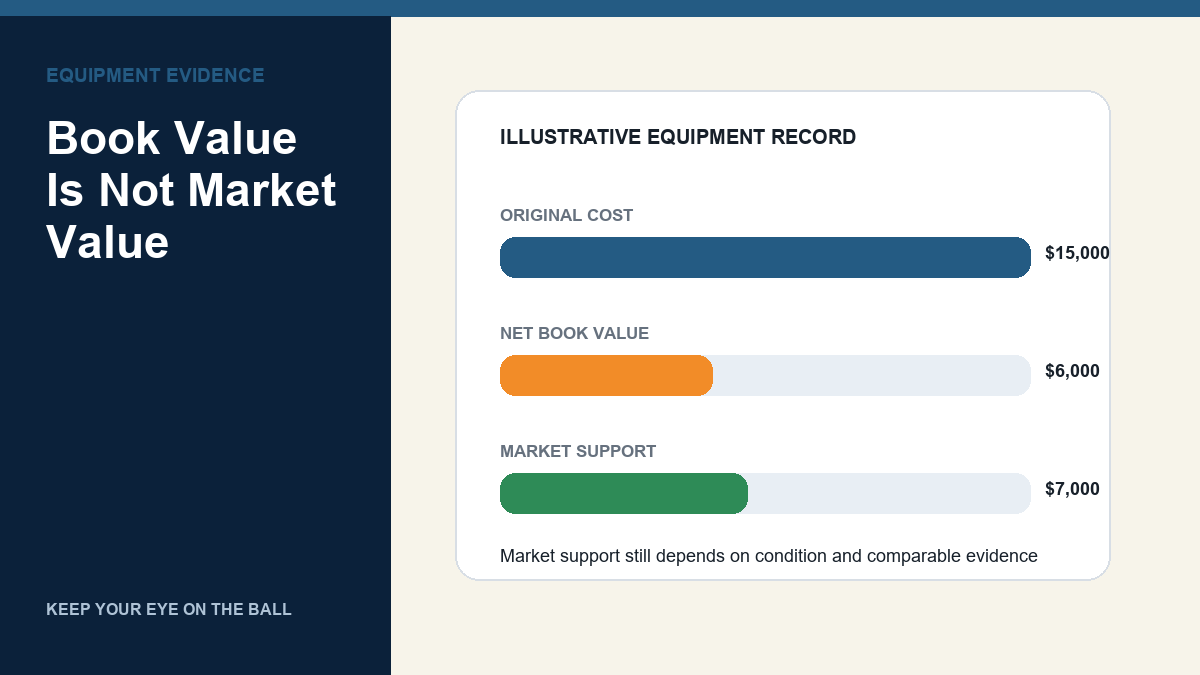
The physical assets of the facility—turf, squat racks, timing gates, and specialized machines—must be properly assessed. It is important to recognize that net book value and current fair market value are different. Fair market value requires separate support based on current equipment condition and comparable used sales.
Hypothetical Calculation: Asset Value Assessment
Example: A facility purchased specialized biometric tracking equipment for $15,000. Under straight-line accounting depreciation over a set period, the accumulated accounting depreciation might be $9,000, yielding a net book value of $6,000. However, the current fair market value might be higher or lower than $6,000 depending on condition, comparable used sales, or a formal appraisal.
Evaluating Intangible Assets in a Coaching Context
Beyond the physical equipment and the cash in the bank, coaching businesses may possess intangible assets. However, a client database, curriculum, or reputation does not automatically have value in a transaction. Transferability, specific permissions, contractual rights, privacy duties, and documented evidence affect whether an intangible asset can actually support a valuation discussion.
Key intangible considerations include:
- Documented Training Curricula: Step-by-step programming that outlines the training product, provided the intellectual property is clearly owned by the business.
- Client Records: A highly organized database of past and present clients. Transferring this data requires careful attention to privacy policies and client permissions.
- Brand Reputation: Established goodwill in the local sports community, often evidenced by consistent organic referral traffic and partnerships with local schools.
- Staff Documentation: Clear role definitions, contract terms, and client-record documentation. The legal enforceability of any staff agreements and their transfer terms require advice from qualified counsel.
Preparing for a Successful Ownership Transition
The process of evaluating a business is ultimately about preparing it for transition. A business with transparent, organized operations is generally easier to evaluate and discuss with potential buyers.
Comparing Data Presentation Methods
The way operational data is presented impacts the clarity of the business review.
| Data Category | Unstructured Approach (Higher Risk) | Organized Approach (Lower Risk) |
|---|---|---|
| Financials | Commingled personal and business expenses with unclear adjustments. | Clean Profit & Loss statements; clear owner compensation records. |
| Client Roster | A list of names in the owner’s phone or a notebook. | A centralized system showing attendance history and cohort retention. |
| Operations | Reliance on the owner for daily problem-solving. | A physical or digital operations manual detailing procedures. |
| Liabilities | No tracking of how many prepaid sessions clients have left. | A precise ledger detailing all deferred package obligations. |
Actionable Checklist for Transition Preparation
Owners considering a transition in the next 12 to 24 months should begin compiling evidence immediately.
- Separate all personal expenses from the business accounts to ensure clean financial statements.
- Document the specific roles and hours worked by the owner to clarify true replacement costs.
- Implement a strict tracking system for all prepaid, unused training sessions to track deferred liabilities.
- Update all staff certifications and verify that agreements are properly documented.
- Compile a comprehensive inventory of all physical facility assets, noting their age, condition, and original purchase price.
- Centralize all client communication and scheduling into business-owned software, removing the founder’s personal devices from the operational loop.
- Begin tracking cohort retention and facility utilization rigorously to document the stability of revenue streams.
Frequently Asked Questions
How do deferred training packages affect a business transition?
Deferred training packages represent an obligation to deliver future sessions that have already been paid for. This obligation must be identified and addressed in the transaction terms, as the specific accounting or purchase-price treatment can differ.
Why is clarifying the owner’s operational role important?
Clarifying the owner’s role helps determine the true profitability of the facility by accounting for the realistic market cost of hiring professionals to perform all the coaching and administrative duties the current owner performs.
What is the difference between a formal appraisal and sale planning?
A formal appraisal is a rigorous, credentialed process often required for tax, litigation, or financing, whereas sale planning involves reviewing operating data to understand market position and identify operational weaknesses before a transition.
How do physical assets factor into the evaluation of a sports facility?
Physical assets like turf, weights, and specialized equipment are assessed based on their condition and comparable used sales. This fair market value is often distinct from the net book value derived from straight-line accounting depreciation.
Do intangible assets automatically increase a coaching facility’s value?
No, intangible assets like a client database or curriculum do not automatically increase value. Their impact depends on transferability, privacy duties, contractual rights, and the documented evidence supporting their contribution to the business.


0 Comments